
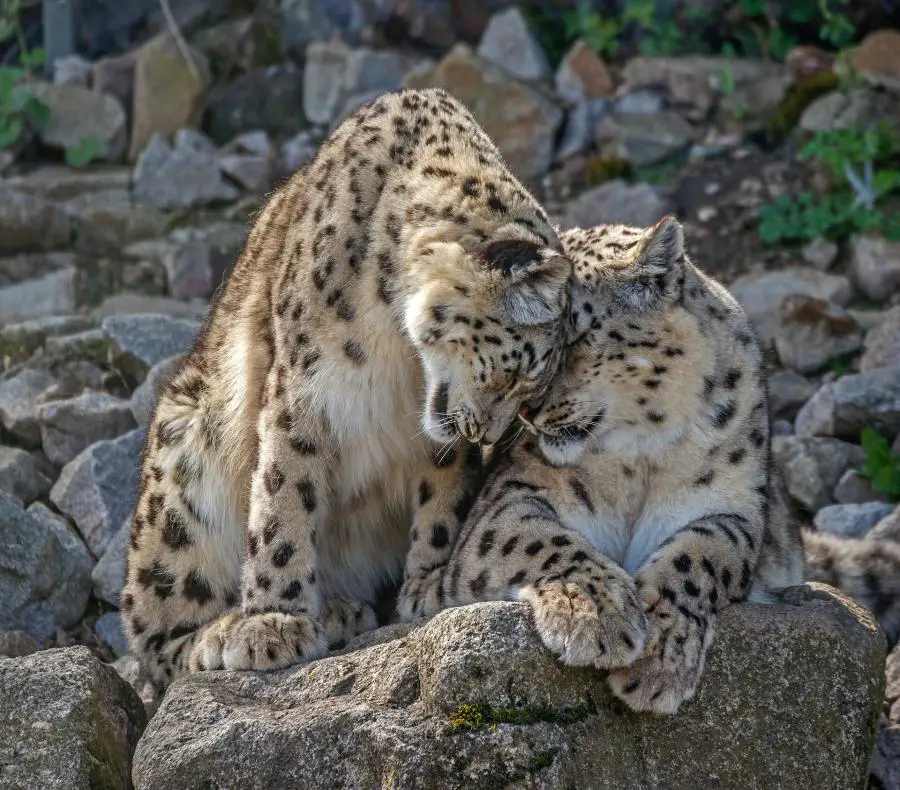
There is a track in the snow the size of a coffee cup. It crosses the ridge, follows the cliff edge for a hundred metres, and then does something careless: it walks off a drop you cannot see the bottom of.
You will not see the animal that made it. That is not bad luck. It is the design.
Last verified 18 November 2026 · reviewed monthly by Nepal Desk
Why your eyes fail, even when it is right there
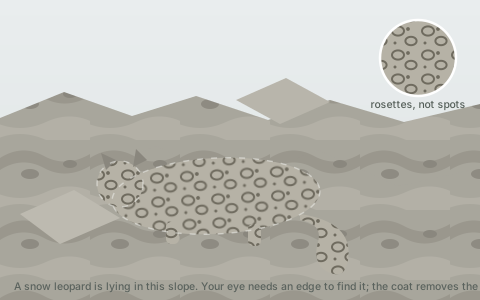
Look at the inset: rosettes, not spots. Large dark rings with a paler centre, scattered over a coat the colour of weathered rock. That pattern does not mimic the mountain. It breaks the animal's outline into pieces too small for the eye to assemble at distance.
A cat lying on a ledge eight hundred metres away has no continuous edge for your brain to catch. You are not failing to look hard enough. You are failing to receive a signal.
The arithmetic no tour company prints
Nepal holds an estimated 300 to 400 snow leopards across roughly 30,000 square kilometres of high range. Call that an order of magnitude rather than a surveyed boundary. Divide one by the other and you get one adult per 85 km²: a square about nine kilometres on a side.
Your trekking route crosses that square once, in daylight, at the hour the cat is asleep on a ledge facing away from you. This is why people who have lived their whole lives in Dolpa can count their sightings on one hand, and why the ones who see one talk about it for years.
What the mountain will give you instead
Read it the way guides do. Pugmarks the width of a palm, with no claw marks, because cats retract. Scrapes in the dust where a tail has swept the ground. A scent mark on a rock at nose height. Blue sheep standing too still, all facing the same slope. A pika colony that has gone silent.
One of those is a better story than a photograph, and it is the one you will actually come home with.
Dolpa, in winter, because of course
The stronghold is Shey Phoksundo, north of the Annapurnas in the trans-Himalayan rain shadow. Dry, treeless, wide open, good for spotting, hard on the legs. Winter is the season, counter-intuitively: snow drives prey downhill, the cats follow the prey, and the pale coat finally has bare rock behind it instead of grass.
It is also the season when the cats come closest to the villages, which is where the next problem begins.
The person who decides whether they survive
A snow leopard that takes a yak calf has just removed a season of income from a family that had little margin to begin with. In much of the world that ends with poison. In Nepal it increasingly ends with a claim form: community livestock insurance, small pooled premiums, compensation for a confirmed loss, and a corral built strong enough that the argument never happens.
It is unglamorous work, and it matters more than any poster. Snow leopard conservation in Nepal is not really about leopards. It is about the economics of a herder's bad night.
Where things stand
The estimate remains 300 to 400, and it has sat in that band for years while camera traps and genetic sampling improved. A number that refuses to move while the method improves is telling you about its own uncertainty, not about the cats.
So watch the food, not the ghost. Blue sheep counts, marmot colonies, the condition of high pasture. Those respond faster, cost less, and can actually be measured.
Photograph and credits
Photograph: H. Zell, CC BY-SA 3.0, via Wikimedia Commons. Infographics are original to Nepal Desk.