
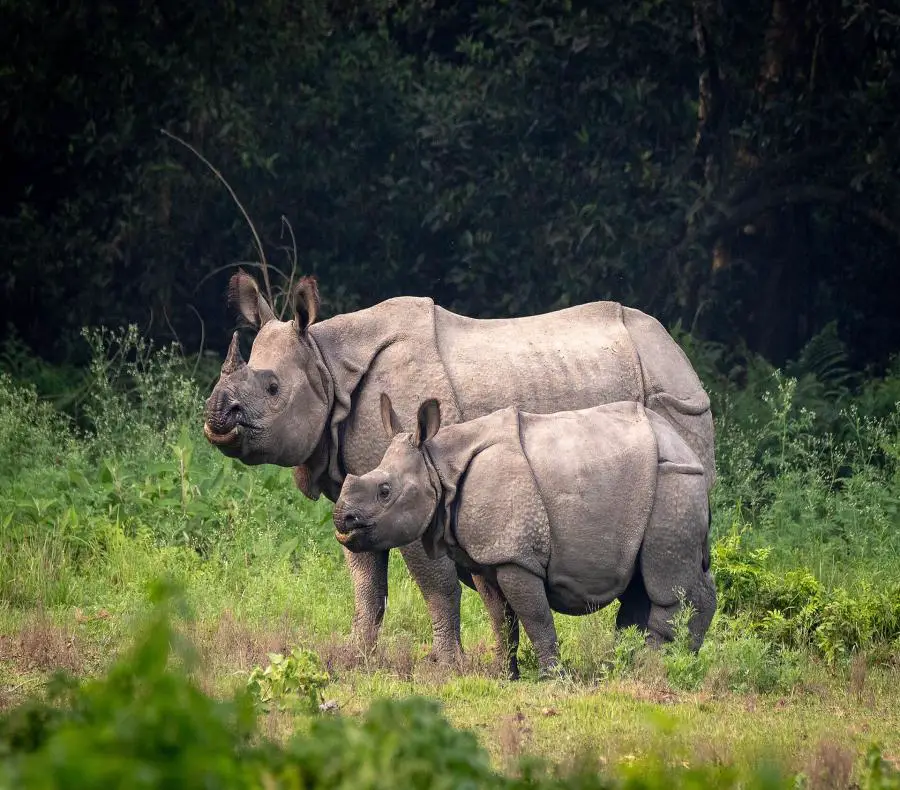
The grass is taller than you are, and the air smells of wet earth and something faintly barnyard. Your guide stops mid-step, one hand up. He points at a wall of green and says one word: gainda.
You see nothing. Then the wall breathes.
That is how most people meet a greater one-horned rhinoceros in Nepal, not as a sighting but as a correction. The animal was never hiding. It simply occupies so much of a place, so quietly, that your eyes need a second to accept it.
Last verified 18 November 2026 · reviewed monthly by Nepal Desk
Everything is the grass
In the wet months Chitwan's elephant grass stands four to five metres high. A rhino inside it shows you a back, one ear, and the horn, and nothing else. By December the grass has been cut, burned on rotation and grazed down, and the same animal is suddenly enormous and completely visible.
This is why February in Chitwan feels like a different country from August in Chitwan. Same park, same rhinos, different height of the world.
The horn is the whole story
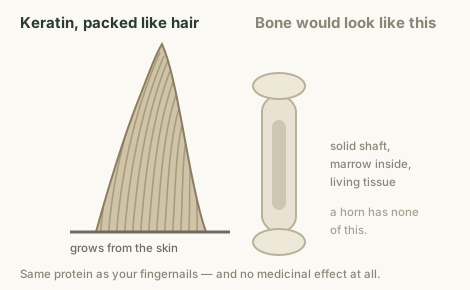
A rhinoceros horn is the same protein as your fingernails, compressed into a cone. It has no medicinal effect of any kind. That is worth saying plainly, because the trade that threatens this animal rests entirely on believing otherwise.
A horn is worth more than its weight in gold. For fifty years men have carried rifles into Chitwan's grass to keep it attached to a rhino.
What a country did after nearly losing them
By the early 1900s the species was down to roughly a hundred animals across its entire range. In Nepal, the turning point has a date: 1973, when the National Parks and Wildlife Conservation Act made the rhino fully protected and Chitwan was gazetted in the same year.
Then come the numbers that matter. 534 in 2011. 645 in 2015, a 21% rise in four years. 752 in 2021.
Seven per cent growth a year, sustained for a decade, is what conservation looks like when it actually works. It is also close to the ceiling: a rhino cow calves roughly once every two and a half to four years. You cannot push a species faster than its biology allows.
Now the uncomfortable part
Of those 752 rhinos, 694 live in Chitwan. One park holds 92% of the national herd.
The Rapti and Narayani flood that floodplain most monsoons; that is what makes it grassland in the first place. Which also means the entire national population now shares one flood risk, one disease risk, and one patrolling budget.
So the rhino story in Nepal has quietly stopped being a Chitwan story. The question is whether Bardia's 38 and Shuklaphanta's 17 can become countries of their own. That is why three rhinos in Parsa are now worth arguing about.
How to actually see one
You do not look for a rhinoceros. You look for grass moving against the wind, for a grey boulder with an ear, for dust rising where nothing should be moving.
Chitwan between October and March gives you three ways in. A jeep covers the most ground. A canoe on the Rapti gives you the best angle on an animal standing in water. Walking in the buffer zone gives you the best guide work and the least margin for error.
The rules are short and not romantic. Never approach on foot for a photograph: a rhino is short-sighted, not slow, and can run at about 40 km/h. If you see a calf, the mother is closer than you think. Stay in the vehicle, stay with your guide, and treat his hand signals as law.
Where things stand
The last range-wide count, in late March 2025, put the world population near 4,075 animals: 3,323 in India, 752 in Nepal.
Nepal's figure has not moved past 752 since 2021, and that flatness is the most interesting line on this page. A population that stops growing after a decade of 7% gains has usually filled the grass it lives in. The number to watch from here is not Chitwan's. It is Bardia's.
Photograph and credits
Photograph: Aditya Pal, CC BY-SA 4.0, via Wikimedia Commons. Infographics are original to Nepal Desk.