


Find a rock face in the middle hills and stand back from it. The birds arrive fast and low, and they do not glide into the nests. They arrive with a snap of the wings, a half-second hover, and then they are inside a mud cup that looks far too small for them. A moment later they are out again and gone over the ridge.
The Nepal House Martin is a bird you can watch for an hour and still not be able to describe. It is 13 centimetres long, blue-black above and white below, and almost all of what you will see in that hour is a white rump flicking away from you. What makes it worth the trouble is everything the silhouette hides: a bird named after this country, a colony that can hold hundreds of nests, and a set of basic facts about its life that nobody has ever published.
Last verified 19 November 2026 · reviewed monthly by Nepal Desk
A bird named after Nepal, by accident of history
The species was described in 1854 by the British entomologist Frederic Moore, and its scientific name, Delichon nipalense, is a small piece of wordplay that has outlasted everyone involved. Delichon is an anagram of chelidōn, the Greek word for swallow. nipalense simply means: from Nepal, because the type specimen was obtained here.
The specimen did not come from a museum expedition. It came through Brian Houghton Hodgson, the British naturalist and Resident in Kathmandu, whose collections fed a remarkable share of Himalayan ornithology in the 1840s and 1850s. Moore credited the bird to Hodgson, which is why the older literature sometimes calls this Hodgson's martin. If you read a paper from before the twentieth century and meet that name, it is this bird.
Its only close relatives are two birds most of the world knows much better: the Asian House Martin and the Common House Martin. Both are long-distance migrants. The Nepal House Martin is not. It is largely resident, drifting downslope in winter rather than leaving the mountains. That single fact shapes almost everything else about it, from when it breeds to why its nests are where they are.
Telling it apart: the marks that actually work
Three house martins overlap in the Himalaya and they are frustratingly similar at distance. The white rump everyone notices is shared by all of them. What separates this species is darker and easier to miss.
| Mark | Nepal House Martin | Asian / Common House Martin |
|---|---|---|
| Chin and throat | Black, the whole throat in north-eastern birds, reduced to the chin further west | White |
| Undertail coverts | Black | White |
| Tail shape | Short and much squarer | Shallow fork |
| Breeding altitude | Mainly 1,000–3,000 m | Overlaps, but breeds lower |
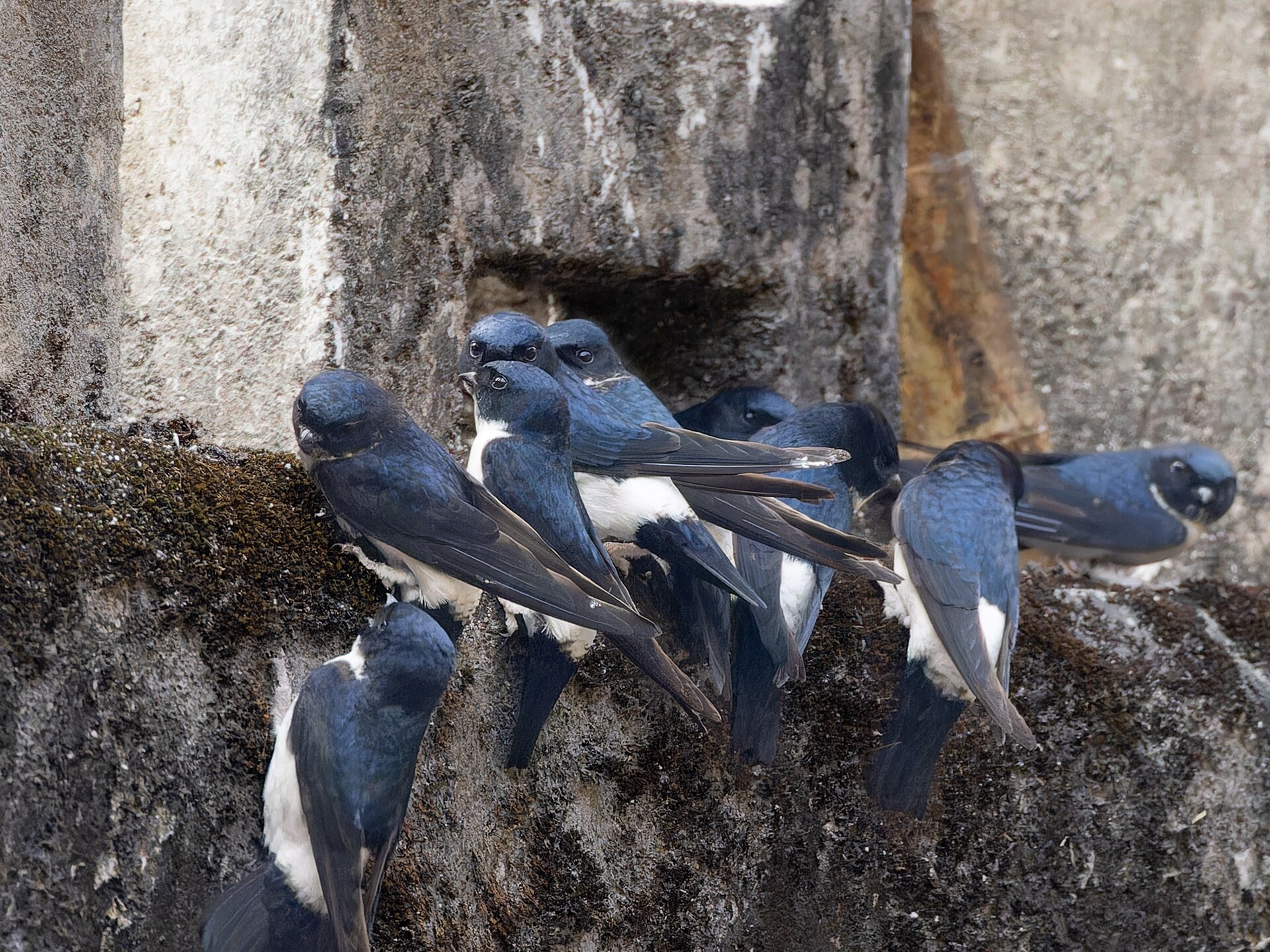
The black chin is not a fixed character, and this is the detail that separates a careful account from a copied one. The dark extends furthest in the north-east of the range, where birds of the eastern subspecies D. n. cuttingi carry black across the whole throat and the top of the breast. Travel west towards Garhwal and the black shrinks back to the chin, so a bird in western Nepal may show very little of it. The undertail coverts, however, stay black everywhere, which makes them the more reliable mark when you are unsure.
Juveniles are duller, with a duskier throat and a buff wash below, and are probably best left unidentified at distance.
The flight is exceptionally fast even by swallow standards, with a short chi-i call that is easy to lose in wind. The bird is otherwise quiet, though it has a brief three-note song at the breeding colony.
A life in the air, and the question nobody has answered
Like all hirundines, it feeds entirely on insects caught in flight, hunting along ridges and over treetops, often in mixed flocks with Himalayan Swiftlets, Barn Swallows, Striated Swallows or Common House Martins. It drinks on the wing. It probably bathes on the wing, as its relatives do.
This is where the obvious question comes from: how long can it stay up? The honest answer for this species is that nobody knows, because nobody has measured it. But the family contains one of the most extreme facts in ornithology. The Common Swift, not a swallow but the same aerial way of life, has been shown by tracking to stay airborne for around ten months without landing, feeding, roosting and even sleeping in flight.
The house martins are not in that league, and it matters to understanding them. A swift can afford to treat the sky as home. A martin cannot: it must return to a fixed nest, on a fixed cliff, and that anchor governs its whole year. Where swifts are free of geography, martins are tied to it.
What limits endurance here is unstudied: insect density, weather, the cost of clinging to rock, or simply the need to return to a nest. That is a tractable research question, and it has not been done.
The colony, and how a nest gets built
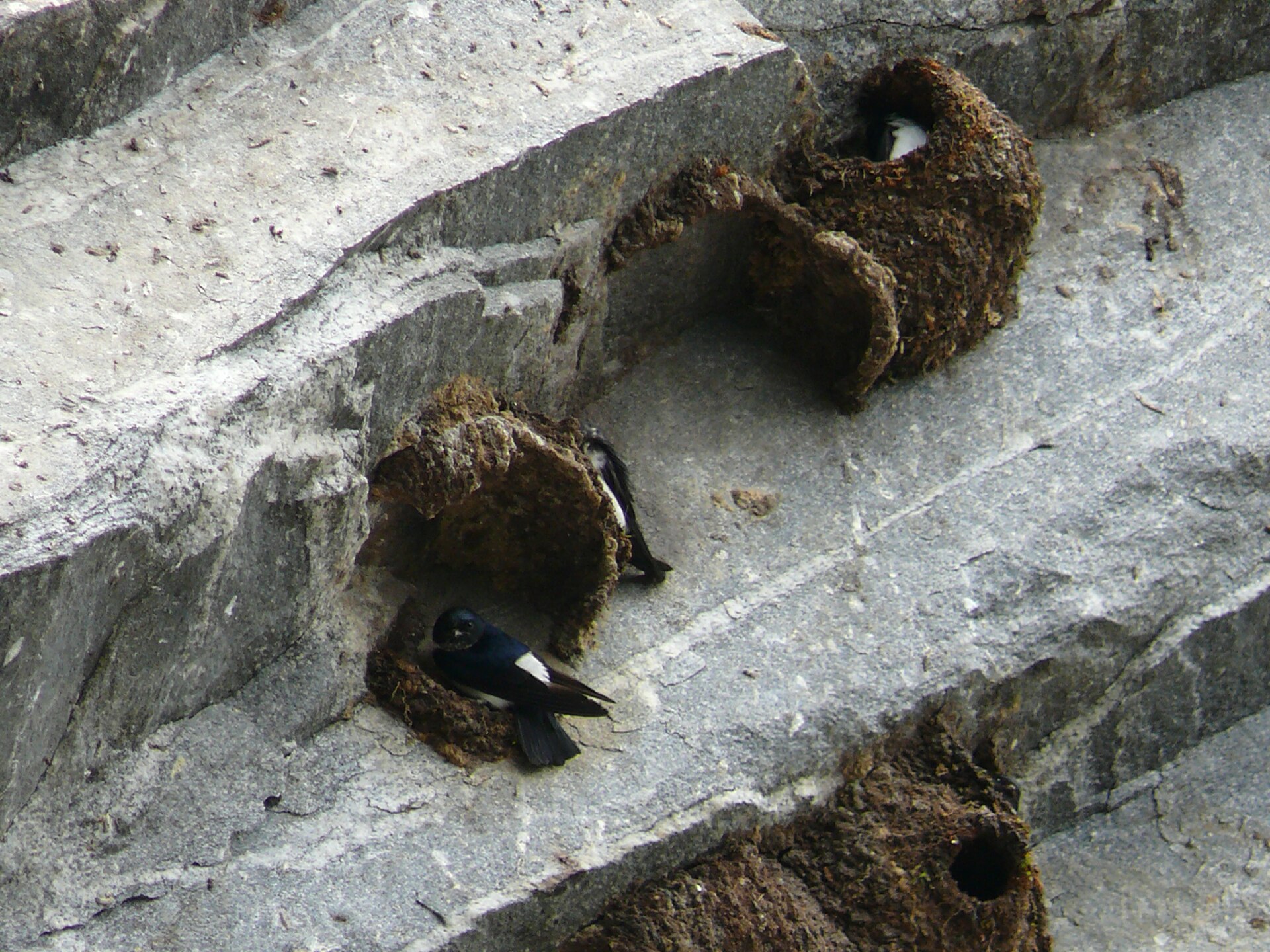
Nests go under overhangs on vertical cliffs: a deep bowl of mud pellets, lined with grasses or feathers, glued to rock where rain cannot reach it. Both sexes build it. Both incubate. Both feed the young.
They nest colonially, and the scale is worth pausing on. Colonies sometimes hold hundreds of nests. A single overhang can be a city. Some birds remain at the colony through the year and use the nests as winter roosts, which turns the site from a nursery into something closer to permanent housing.
The breeding season runs roughly March to July, with local variation, and pairs usually raise two broods. The clutch is three or four plain white eggs, each about 18.6 by 12.8 millimetres and weighing roughly 1.6 grams.
Buildings are rarely used. The one well-documented exception is in Sikkim, where the species has been recorded nesting under school roofs near the Fambong Lho Wildlife Sanctuary, a reminder that "cliff nester" is a strong preference rather than an absolute rule.
What nobody knows yet
Most bird profiles sound finished. This species is not, and the gaps are specific enough to be useful to anyone thinking about a project.
- Incubation and fledging times are unpublished. The best available estimate borrows from the Common House Martin: roughly 14–16 days to hatch, then 22–32 days to fledge. That is an inference, not a measurement.
- The diet is barely known beyond "flies and other insects".
- Flight endurance is unmeasured: no one knows how much of its day is spent airborne.
- Predators are almost unstudied. The species was the only bird found in one study of the Collared Falconet's diet.
- A flea of the genus Callopsylla has been recorded as a parasite, and that is close to the sum of what is known about its parasites.
- Its status in Thailand is poorly known, where it occurs on passage.
For a student or a researcher, that list is an opportunity. A colony is a fixed site you can return to; the birds are fast but countable; a trail camera or a long lens can answer questions here that no one has answered anywhere.
Where to look in Nepal
Look in river valleys and on rugged, wooded ridges between roughly 1,000 and 4,000 metres, mostly below 3,000. The requirement is not elevation but geometry: a vertical, overhanging rock face near open air where insects can be caught.
Because the bird is resident rather than a summer visitor, you can find it across the year, although non-breeding birds descend, sometimes to 300 metres and occasionally lower, so the cliff that is busy in spring can empty out in winter. Watching a known colony in both seasons teaches you more than a checklist does.
The searching method is almost embarrassingly simple. Find a cliff, put the sun behind you, and watch the overhangs rather than the birds. They return to the nest line every few minutes, and the nest line is where you will finally see the black chin instead of a white blur.
The abundance contradiction
Two statements about this bird sit awkwardly together in the literature. The species is described as fairly common in Nepal as a whole and very common in parts of it, and yet earlier authors recorded it as uncommon here.
Both can be true at once. This is a bird confined to suitable cliff faces, so it is highly localised even where it is numerous: abundant along one gorge, absent from the next valley. A birder driving a road can reasonably see none all day and conclude it is rare. A colony count in the same district can record hundreds of nests.
Which is exactly why records matter. The species is evaluated as Least Concern, with a large range and apparently stable numbers, but the population has never been quantified. "Least Concern" here means "no evidence of decline", not "known to be fine", and those are different things.
How to watch it well
Arrive early. Insects rise with warming air and the colony becomes busy once thermals start; midday in a gorge can go quiet.
Spend the first ten minutes doing nothing but watching the nest line. You will learn the colony's rhythm: which nests are occupied, which birds are feeding young, and roughly how long an absence lasts. Once you know the rhythm, identification gets much easier, because you can predict where a bird will reappear.
Then look at the birds against something dark rather than against the sky. The white underside of a martin vanishes against cloud and appears crisply against rock. This is the single most useful technique for separating these species in Nepal, and it costs nothing.
Finally: do not disturb the cliff. Nests sit under overhangs for a reason, and a colony that is approached from below at the wrong angle will simply leave. The best observation points are far away and inconvenient, which is part of the point.
Photographs and credits
Colony on a rock face, Neora Valley National Park, February 2026: photograph by Tisha Mukherjee, licensed CC BY-SA 4.0, via Wikimedia Commons. Mud nests under a rock overhang, Bhutan: photograph by chia_alfred, licensed CC BY 2.0, via Wikimedia Commons.


Both photographs are used under their licences with attribution. Respect the photographer: do not re-use these images elsewhere without the same credit.